

Most organisations hold building information they cannot confidently act on. The full Asset Intelligence framework is now open to anyone who wants to read it, use it and build on it
Asset Intelligence is the discipline that ensures the people responsible for buildings can find, trust and act on the information they need to keep them safe, compliant and performing.
Glider created the discipline and introduced it in these pages in June. Last time I looked at where it starts on site. This time the subject is the framework itself.
Why we created Asset Intelligence
The standards already existed. ISO 19650 and ISO 55001 describe what good looks like, yet neither has been adopted at scale across the whole lifecycle. The industry does not lack knowledge of what good asset information looks like. It lacks a discipline to deliver it.
As I see it, the problem had no home. It sits between disciplines. It is too operational for construction technologists, too technical for facilities teams and too niche for enterprise software vendors. So every organisation tackled it alone, with no shared vocabulary, no way to benchmark progress and no recognised practice to train towards. Naming the discipline and writing it down gives it a home.
That is also why it has to be published. A discipline held inside one company is only that company’s view. It becomes useful when the people who practise it can adopt it, test it and improve it.
When building information stops being usable
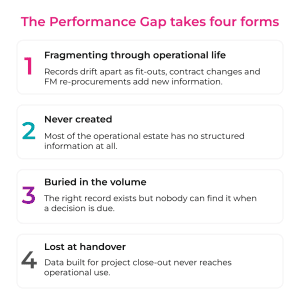
We call the gap between what an organisation holds about its buildings and what it can confidently act on the Performance Gap. It takes four forms.
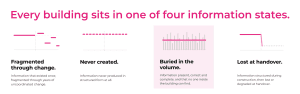
- Information fragments through operational life, as fit-outs, contract changes and FM re-procurements leave records that nobody reconciles.
- Information was never created in structured form, which is true of most of the operational estate.
- Information is buried in the volume, correct and present but impossible to find when a decision is due.
- Information is lost at handover, when data built for project close-out never reaches operational use.
Compliance failures, reactive maintenance, repeated surveys and capital decisions made on weak evidence all trace back to information that people cannot trust.
How Asset Intelligence relates to ISO 19650 and ISO 55001
Asset Intelligence complements both standards. ISO 19650 sets out how built asset information is produced and exchanged. ISO 55001 sets out how assets are managed. Asset Intelligence is the practising discipline that makes both work across the whole life of a building, from design intent through decades of operation to disposal.
It is something an organisation practises. Software can enable it, but the discipline exists independently of any platform.
What’s in the framework
The framework is six documents. The Thesis sets out why the discipline is needed. The Definition says what it covers and where its boundaries sit. The Architecture describes the practice itself, in five functions and 15 capabilities, from defining requirements through to using information to decide and act.
Three models help organisations apply it. The Maturity Model shows where an organisation stands on each function. The Adoption Model explains what moves it up a level and why so many stall. The Value Realisation Model sets out where the value comes from, which is risk reduction, cost avoidance, decision quality and speed, and outcome achievement.
There are two pathways in. Create applies to new build and major refurbishment projects, where structured information can be produced right the first time. Recover applies to existing buildings, where information has to be rebuilt. Most buildings already exist, so most organisations will start with Recover.
Who can use the framework
Anyone can use the Asset Intelligence framework. Glider authored it and helps organisations to practise it, but it sits on its own website and is written for owners, operators, contractors, consultants and technology providers, including those who compete with us.
The six documents and a short summary can be read without filling in a form. Each is published as Edition 1, with a date and a citation. The framework will be reviewed regularly, and the site explains how practitioners can contribute. For a quick view of where your organisation stands, Glider offers a free Maturity Indicator on glidertech.com.
Where to start
The framework has been published and is now available to read at https://assetintelligencediscipline.org.
Delivery teams should start by reading the Architecture and look at what they hand over and to whom. Asset owners could start with the Maturity Model and ask which function would be hardest to evidence today. The answers will differ, which is why the discipline needs more than one voice.
The site explains how to get in touch and contribute if you have any feedback or comments.
Please note: This is a commercial profile