
Europe’s modular construction sector has the manufacturing expertise to help address housing shortages, labour constraints and pressure to build more sustainably
What it has often lacked is a coordinated voice across national borders, particularly as European policymakers develop rules that could determine how factory-built buildings move through the Single Market.
The Modular Building Institute (MBI) is working to fill that gap. An international trade association representing commercial modular construction, MBI now represents 65 member organisations across 16 EU countries. Its growing European presence is increasingly visible through industry collaboration, legislative engagement and opportunities for knowledge-sharing.
Building a coordinated European voice
MBI’s European presence predates 2026, but its structure has changed significantly this year. In July, it appointed Kellen as its Brussels secretariat; in August, it joined the EU Transparency Register. A dedicated policy workgroup now gathers members’ views and follows legislative developments, supported by regular policy updates.
Regional engagement is equally important. MBI Benelux connects members in Belgium, the Netherlands and Luxembourg, encouraging collaboration beyond national boundaries.
Pieter Schoofs of Belgian modular manufacturer Skilpod, who chairs the Benelux group, describes its purpose as “bringing a louder voice for modular building in Europe or across the world.”
The approach reflects a commercial reality: modular producers increasingly work across borders, while approvals, certifications, procurement practices and insurance requirements remain largely national. A collective voice can help address these inconsistencies.
Amsterdam brings the industry together
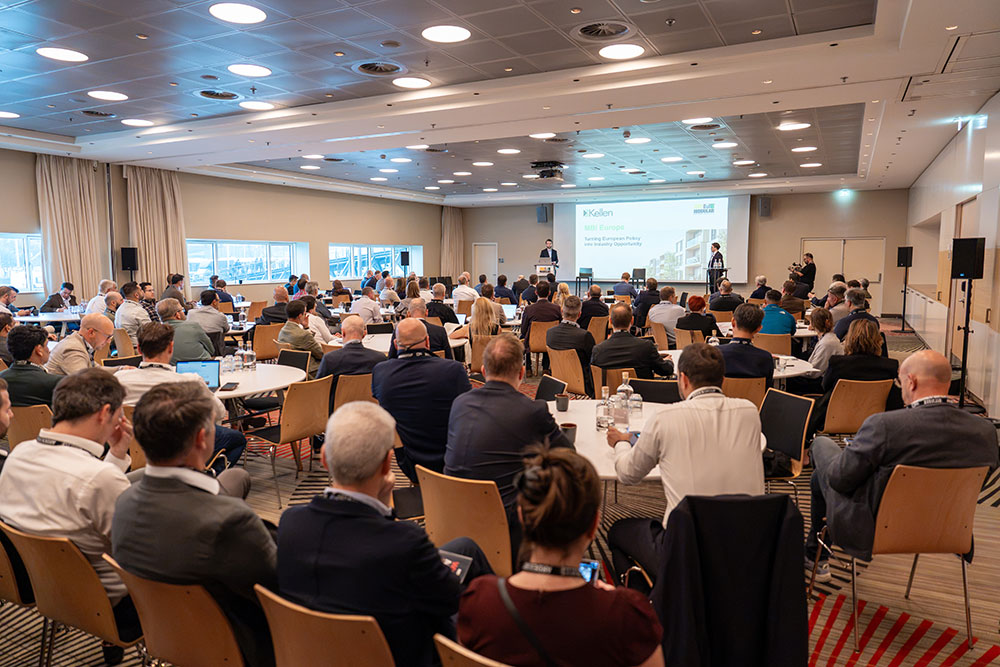
MBI’s recent World of Modular Europe conference in Amsterdam demonstrated the value of bringing the industry together. Held in October, the event attracted its largest European attendance to date, gathering manufacturers, architects, developers, technology providers and standards specialists from Europe and beyond.
Alongside sessions exploring manufacturing innovation, digital technologies and building design, MBI Europe hosted discussions addressing European regulation, Digital Product Passports and the proposed Circular Economy Act. Factory tours provided opportunities to examine modular production methods first-hand.
For Dwayne Torrey, director of construction and infrastructure standards at CSA Group, the international exchange is particularly valuable when different countries approach modular standards inconsistently.
“That conversation wouldn’t happen if it wasn’t for MBI,” he observed.
Ryan O’Reilly, chief commercial officer at manufacturing software company WrxFlo, highlighted another benefit of participation: “people in Europe talking to lawmakers and influencing how decisions are being made about what happens next.”
Together, these perspectives illustrate MBI’s ability to connect technical expertise, commercial interests and policy discussions.
Taking the industry’s concerns to Brussels
That engagement extends directly to European institutions.
On 3 November, MBI European membership director Alan Milne joined MBI Europe’s policy director Alex van der Laan and regulatory affairs manager James Hammersley in meetings with the European Commission’s directorate-general for internal market, industry, entrepreneurship and SMEs (DG GROW).
Discussions addressed two issues of considerable importance to modular manufacturers: Digital Product Passports and the proposed Construction Services Act, which aims to reduce barriers to providing construction and installation services across EU borders.
MBI is also working to influence implementation of the revised Construction Products Regulation (CPR), particularly how modular units and prefabricated building systems are defined and assessed.
Said van der Laan: “Following the DG GROW discussions, MBI was encouraged to apply for participation in the CPR Acquis process, where future technical requirements will be developed. The CPR Acquis process brings together the Commission, Member States, and industry experts to develop and update the technical specifications underpinning the Construction Products Regulation, giving stakeholders an opportunity to contribute practical expertise as the requirements for modular units take shape.”
MBI’s European engagement also includes building relationships with other construction organisations. During the same week, Milne visited the Buildwise innovation centre at the invitation of the European Construction Industry Federation (FIEC). Buildwise supports construction innovation, quality and sustainability, offering opportunities for cooperation and knowledge exchange across the wider sector.
These activities complement MBI’s ongoing monitoring of European legislation concerning industrial competitiveness, building renovation and circular construction.
Turning representation into lasting influence
Beyond regulatory engagement, MBI is advocating for greater recognition of modular construction’s potential contribution to European sustainability objectives.
Its work on the proposed Circular Economy Act, for example, encourages policymakers to recognise the reuse and relocation of complete building modules, rather than focusing exclusively on recycling construction materials. And beyond that, MBI is following a broader range of EU legislation, including the Public Procurement Act and Industrial Accelerator Act. MBI members receive direct updates and briefings on these files, as well as opportunities to help prioritise issues and contribute their expertise to MBI’s advocacy efforts.
For Mirna Dalal, founder of construction software business Esembl, membership also creates opportunities to advance innovation.
“Being a part of MBI helps me share innovations, connect with other people, and learn from their innovations,” she said.
MBI’s European policy programme is still developing, and its long-term effectiveness will depend on translating industry experience into practical regulatory improvements. Nevertheless, its growing membership, engagement with European institutions and success in convening industry professionals demonstrate an increasingly influential role.
For a sector navigating fragmented regulations while seeking opportunities to expand, MBI is helping establish the coordinated industry voice needed to support modular construction’s continued development across Europe.